

41.000 stars — the visual story.
01 / 08
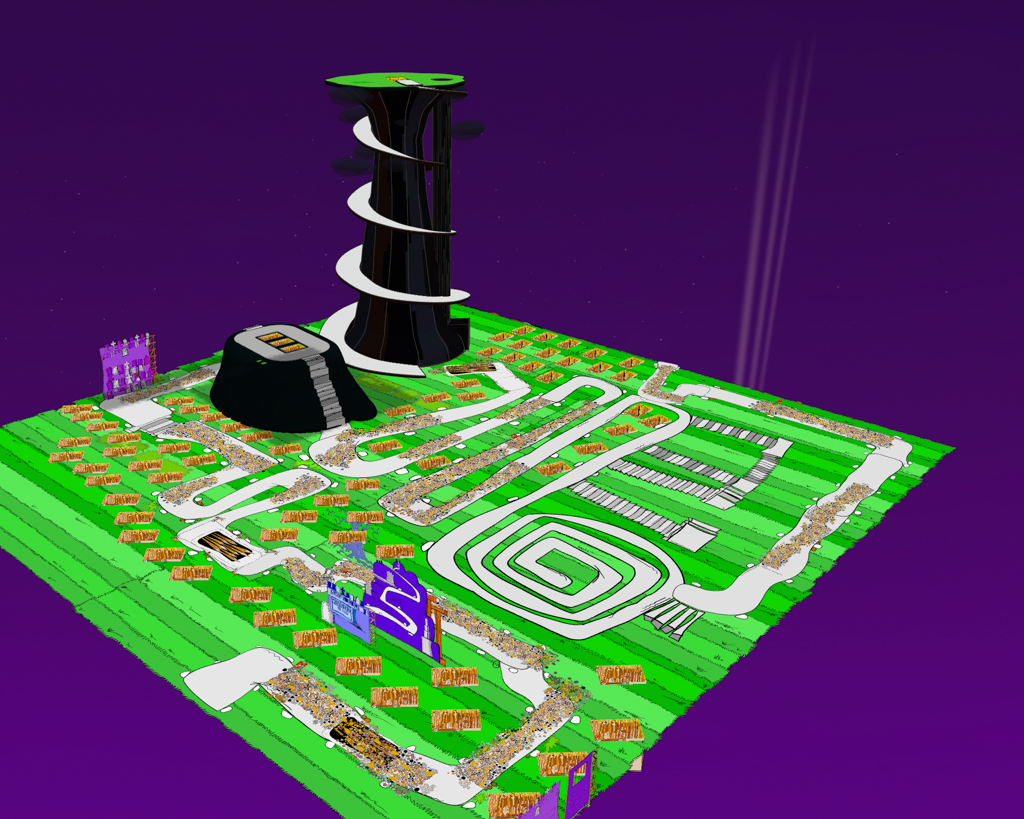
The new wide review frame keeps the whole hand-drawn yard in view beneath the violet star field. The sky is part of Crookwood, not a detached test strip.
Who spent last night creating star fields above a comic world?
I did.
It began when I took a critical look at the stars above Crookwood and decided they were too large and ugly. I had 'painted' them in, using a star brush in Fresco. They looked less like stars and more like white smudged blobs. Not Fresco's fault. Just what we were attempting.
They came from six authored night plates. Those plates had served their purpose, but the closer the game came to becoming a world you could walk through, the less convincing the stars became. Carny Island is hand-drawn but this comic world still needs a real night sky. Especially because most of the game is played at night when Crookwood is closed. The best time to desecrate a grave. (You can rob graves in broad daylight - at funerals and open coffins. But that's game play and we're not at the game play building stage yet..)
Carny Island is set near Coney Island in Brooklyn. The game mirrors New York days, weather, tides and the Moon because the real world affects the game world: winter ground is harder to dig; a dull day in New York is a dull day on Carny. Shrift can still make it rain whenever he chooses, because Crookwood is also a comic theatre. Reality is the authority. The comic cheats are mine.
So I asked Codex whether the generated stars were actually modelled on the Northern Hemisphere above New York. They looked a bit standard to me.
They were. The first solution used New York latitude, Polaris and sidereal rotation, but the individual stars were procedurally scattered. It was New York-oriented, not a literal New York star field. Mathematically plausible wallpaper. It looked like a kid's bedroom ceiling.
The Big Dipper became the truth test. If I could not look up from Crookwood and find the Big Dipper, I was not looking at the Northern Hemisphere. I was looking at decoration. North American players would know the difference, and the detail mattered.
That sent the machines into the astronomical catalogues. The first Tycho-2 download produced 41,485 measured stars down to magnitude 8. But Tycho-2's main table omitted several saturated naked-eye anchors, including Polaris and Vega—the stars people actually recognise. Those were restored from the Bright Star Catalogue and deduplicated against Tycho-2.
The merged result contained 41,695 points of light. Hence the title.
It sounded like victory. Then Apple's Metal compiler objected to one perfectly innocent variable name because the computer had already reserved it for itself. One word brought the heavens to a halt.
That was corrected, the catalogue loaded and the visual gate began. This is where numbers stop being reassuring. The first inspection found only 5 visible star components. Forty-one thousand stars had entered the machine. Five had made it onto the screen.
The next attempt found 540. Better, but still not enough to create the depth of a real night sky. Making the pins larger only caused neighbouring stars to merge. Making them brighter did not create stars that were not geometrically present in that patch. The catalogue could be astronomically correct while the picture remained visually dead.
So the catalogue went deeper, to magnitude 8.75. The merged field grew to 92,322 real records. The next packaged review measured 1,182 separate tiny pin lights in the inspected top strip alone. No radial bursts. No giant Christmas decorations. Polaris could be brighter, but never larger.
The real New York clock remained intact. The authored Moon became tied to New York's date, time, path and phase. The six-minute sweep described here was the July test model; on 5 September 2026 it was superseded by a 24-minute sunset-to-sunrise Crookwood night. The moving shadows across the graveyard remained. And the Big Dipper was finally where the Big Dipper belonged.
This is one of the strange pleasures of building Carny Island with machines. I drew a comic graveyard. Then, years later, I found myself feeding NASA astronomical catalogues into Metal so the dead could be buried beneath the correct stars.
Last night I thought: I must be one of the luckiest guys in the world. Who gets to create star fields above a comic world?
I do.
That does not mean the whole game is finished or the build has passed. The sky's own review is machine-green. The wider Golden and Tool Matrix gates are still red. Nothing was installed. The sky still has to survive my eyes while I drive the actual world.
So this is not a marketing victory lap. It is simply how 41,000 points of light became 92,322 catalogue records, which became 1,182 tiny marks above a hand-drawn graveyard. Somewhere among them sits the Big Dipper. Ridiculous. And exactly right.