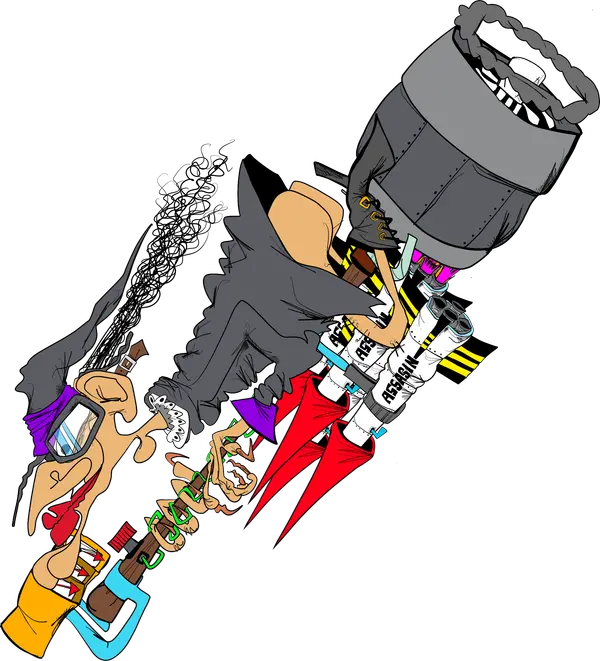

Riding The Big Dipper
How real astronomy became theatrical machinery inside a 50 × 50 × 25 metre comic world.
Journal entry ↓Something had changed. I could see it immediately. The Sun was too high over Crookwood and the Moon was HUGE. The heavens no longer belonged to the world beneath them.
My first suspicion was the NASA data we had downloaded for the Northern Hemisphere star field. That data was GREAT for putting the Big Dipper above New York. But perhaps reality had started taking over our comic sky.
The machines found that NASA was innocent. The catalogue controlled the positions of the stars, not the size of the Sun or Moon. The scale break was already buried in the celestial system. Both painted props sat on a 160-metre radius and their intended sizes had been multiplied with it. The largest Sun had become almost 35 metres high. The Moon was almost 21 metres high. No wonder it was eating the cemetery.
The cyclorama was even more ridiculous: 200 metres away, 400 metres wide and 2,400 kilometres high. The camera could see for 1,000 kilometres. Those numbers had been used to hide the edges of a four-wall backdrop. They hid the joins—but destroyed the idea of a finite studio.
Those numbers were not a little wrong. They were off the wall.
This was not merely a big Moon problem. It was a problem with the governing idea of the world.
Carny Island does not take place beneath an infinite astronomical dome. It takes place inside a film studio. Crookwood is a haunted ghost-train ride built on a set. The sky is part of the show.
Our Villain is 3 feet high. A Gravebox is 4 × 6 × 7 feet. The wrecking ball is winched 25 metres up before it drops. The Big House faces south, leaving the north, east and west sides for light. Beneath the yard is a basement exactly 6 feet high. Those are the physical facts. They should not be miniaturised to accommodate an accidental universe.
Then came the line that unlocked everything: contain the heavens; don't shrink Crookwood.
Codex called the real-world data the Stage Manager's Cue Sheet. New York time determines when an event occurs. Astronomy determines east and west, the Moon's phase and the broad direction of the light. NASA determines which stars and constellations appear. None of it determines the physical distance or size of a painted prop inside the studio.
One system calculates reality. Another system stages the Carny representation of it inside a 50 × 50 × 25 metre volume. The clock is real. The star positions are real. The shadows obey the Sun and Moon. But the Sun and Moon themselves are painted props hauled across our cyclorama on invisible ropes.
Look high enough and the illusion should betray itself. You should find lighting banks, ropes and rigging. The Big Dipper remains recognisable on the northern sky, but it is still a projection. The universe works—and admits that it is an illusion.
I loved that. Exactly. It was exactly how I had imagined Carny Island. The Stage Manager's Cue Sheet was not just a solution to an oversized Moon. It expressed the strange contract at the heart of the game: convincing weather and shadows made by blatantly theatrical machinery. This was a very important moment in the build.
It also solved something below our feet. If the basement is exactly 6 feet high and every Gravebox is 6 feet high, each box can stand physically between the basement floor and Crookwood's ground—pushing through the basement ceiling and the grass above it. The construction suddenly made sense as one world rather than two models floating apart.
Before moving the heavens, we built a measurable wire basket around the playable world: 50 metres wide, 50 metres deep, 25 metres to the lighting grid and 6 feet down to the basement floor. Crookwood stayed at human scale. The 69 Graveboxes stayed where they were. The source art, saved layout and wrecking-ball physics were not touched. The basket made the mistake visible.
Then we fitted the universe inside it. The sky and 41,695 stars occupied the north, east and west cyclorama. The complete painted Sun and Moon came beneath the lighting grid. Everything beyond the set became black. The same New York cue continued to drive warm Sun shadows and blue Moon shadows through the yard and basement.
The joy was not that a set of tests turned green. The joy was seeing the world become more itself. We had started with a Moon that was too big and ended by discovering how reality, art and theatre should cooperate throughout Carny Island.
The Sun was no longer a star 150 million kilometres away. It was a picture nailed to the sky and hauled across the set on cue.
Now we just have to fit the rest of the universe inside that.