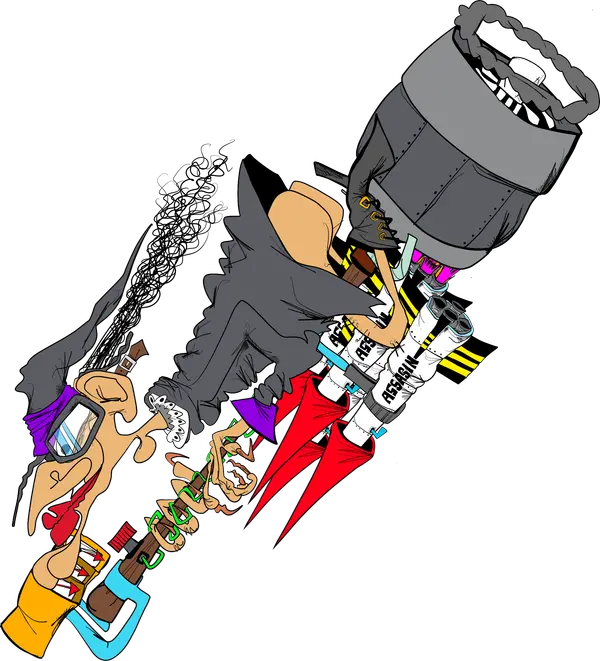

The Solo Dev Log: One Grave
The plan is to prove Carny Island inside one engineered grave, update the WebGL build weekly and give gamers, the wider world and investors three entrances into the same work.
Journal entry ↓I was quoted $150,000 and 10 months "easy" to build this tiny slice of our game. I did it in two weeks for about $500 with Sol and Claude.
As of today, my plan as a solo developer is to continue evolving the main loop.
Whatever happens, we still need to build an audience.
We cannot afford advertising campaigns. We need word of mouth. We need gamers talking, because the PC release is where the game will be worked thoroughly. And we need the wider world talking, because the larger ambition is to own Halloween.
Those two lines need to intersect.
That means showing the development of Carny Island as it happens: screenshots on Instagram, playable WebGL updates and posts on carnyisland.com, Substack and LinkedIn.
My history as the inventor of Nightmare/ATMOSFEAR may earn me attention. It will not make this game work. The game has to do that.
A game anybody can operate
My real play is to deliver a video game that can be played using only a mouse.
There is room at the bottom of the interface on either side of the keyboard. To the right, I will introduce a directional pad. Click the left arrow and the Villain moves left.
To the left of the toolbar, I will add a spring that makes the Villain jump or duck.
The ambition is that an 89-year-old woman in a nursing home can understand how to navigate and play.
That is the end game: bringing fun to what can otherwise become the last lonely stop before the yard.
Carny does not pretend death is somewhere else. It brings death into the room and makes it ridiculous, theatrical and playable.
Then we launch the Video Board Game in a nursing home on Halloween.
One grave
I will update the WebGL build each week.
Refining it. Adding elements. Making each version a little more disturbing. More polarising.
At the moment, I am working with one top-down camera angle and two shots: a wide and a mid.
There is no establishing shot showing where the grave is. No wide view of the outside world, what it contains or what may be coming.
That limitation is deliberate.
Scope creep kills games. By concentrating on one camera angle and one scene, I can concentrate on the gameplay.
The job is to make the excavation and dissection of one body awesomely fun. If I can also change the personality of that grave quickly, I can eventually fill an entire graveyard.
But first, one grave must work.
The loop takes place inside a three-dimensional engineered box. I never approached it simply as art. I approached it as a piece of engineering fantasy that would generate gameplay ideas.
Combined with the interface, that box can turn a claustrophobic grave pit into a world of mechanics and economics—each grave shaped by the corpse and by the life and times of the person who once occupied it.
Changing the occupant
The corpse's appearance can change through a Carny Corpse ‘Identikit’ system: different eyes, noses, hair and other features can create a new identity.
The wardrobe can change. So can the props, loot, coffin, state of decay and things inhabiting the grave.
When the player stops and faces a headstone, we cut to its engraving. Who lies here? When did they die? Is this grave worth robbing?
The substrate system
The layers beneath the ground need to change with local New York conditions: wet earth, dry earth, frozen ground and ice.
Different substrate layers will give each excavation visual and mechanical variation. The rubbish buried in the fill can also change.
Then there are the KA_PLUK noise bombs: underground chain reactions.
Pull out a car tyre. It causes a cave-in. The cave-in bursts a sewer pipe. The pipe fills the Gravebox with sludge.
A single decision creates a sequence of consequences.
Game time
The approach tunnel is dark and untimed. Entering the Yard begins a 24-minute sunset-to-sunrise Crookwood night. A grave rob takes approximately 12 minutes: a playable compression of the hours required to excavate a 6 × 4 × 7-foot grave by hand, grounded in the real task without pretending to be exact science.
Darkness descends. The light changes. The sun rises and sets. Shadows race across the screen.
It will rain, snow and sleet.
The coffin will ooze gases. Insects and maggots will emerge. Pipes will burst. The substrate will change. The occupant, coffin, loot and ghosts will vary.
Then the pipe system comes alive: whatever comes down from Shrift's cottage, including the consequences of Shrift's drunken rampages.
Gweedo's must also become operational, allowing the player to trade parts of the corpse while dissecting it.
That necronomic economy adds another dimension to the excavation.
And still, we have not left one grave.
The body
The body needs work, but it also offers an enormous amount of entertainment.
I need a system supporting four states of decay and an animated process of dissection: meat coming away from bone.
At present, this has only been blocked in.
Bringing in the Villain
I want to introduce the Villain—the Scritch—through shadows cast into the grave as tools are used and the body is robbed.
That will be one of the most difficult effects to achieve because it depends on convincing lighting.
If it works, however, the player will finally become physically present inside the scene. From there, I can begin introducing three-dimensional threats.
Then things can become amazing very quickly.
What must be proved
One grave is not a small undertaking.
Weather, fluids, lighting, substrate, four states of decay, modular identities, loot, ghosts, trading, pipe events, dissection and physical-board integration collectively constitute a substantial game.
The danger is adding all of them before proving the loop underneath them.
The immediate target is one complete experience: enter the grave; understand the objective; dig and make meaningful choices; encounter escalating consequences; reach a clear success, failure or extraction point; and want another attempt because the grave may behave differently.
Until someone who did not invent Carny plays that grave and genuinely wants another go, the main loop remains unproven.
The nursing-home idea must also be tested honestly. Mouse-only does not automatically mean accessible. Vision, hearing, tremor, cognition, target size, timing pressure and fatigue all matter.
The idea is powerful. Now the game has to prove it.
Why show the work?
There may be no singular revolutionary mechanism here that must be hidden.
The originality is in the condensation.
Individual ingredients can be named: WebGL, grave robbery, modular corpses, changing weather, mouse controls, procedural variation and board-game interaction.
Carny is the particular integration of those ingredients: an authored world and visual language; a grave functioning as a reusable engineered stage; accessibility embedded in the game's purpose; a physical Video Board Game; a nursing-home Halloween proposition; death transformed from private dread into communal entertainment; and one author working with machines at unusual speed.
Copying the ingredients will not reproduce the taste, judgement or velocity.
So the disclosure strategy is simple: show the experience. Protect the machinery.
Show the visible weekly changes, short passages of play, atmosphere, consequences and evidence of progress.
Hold back the complete architecture, detailed production pipeline, full inventory of interactions, major surprises, economic model, private roadmap, budgets and investor terms.
The three audiences need three entrances into the same work. The gamer gets the mechanic. The wider world gets the meaning. The investor gets the trajectory.
Build once. Capture once. Tell the truth three ways.
Every weekly release must contain something people can actually see: a new interaction, consequence, transformation, threat or laugh.
Over time, those releases stop being claims about what I intend to do.
They become evidence that Carny Island is gathering speed.